

Welcome back to The Political Spectrum. We’ve got four days until polls close. You may have seen this week that I was in Atlanta this week. I have a piece coming out this weekend that chronicles that. But for now, here’s another dispatch from Georgia. Remider, I can’t do this without your support, so subscribe or contribute at Ko-Fi.com/EricMGarcia.
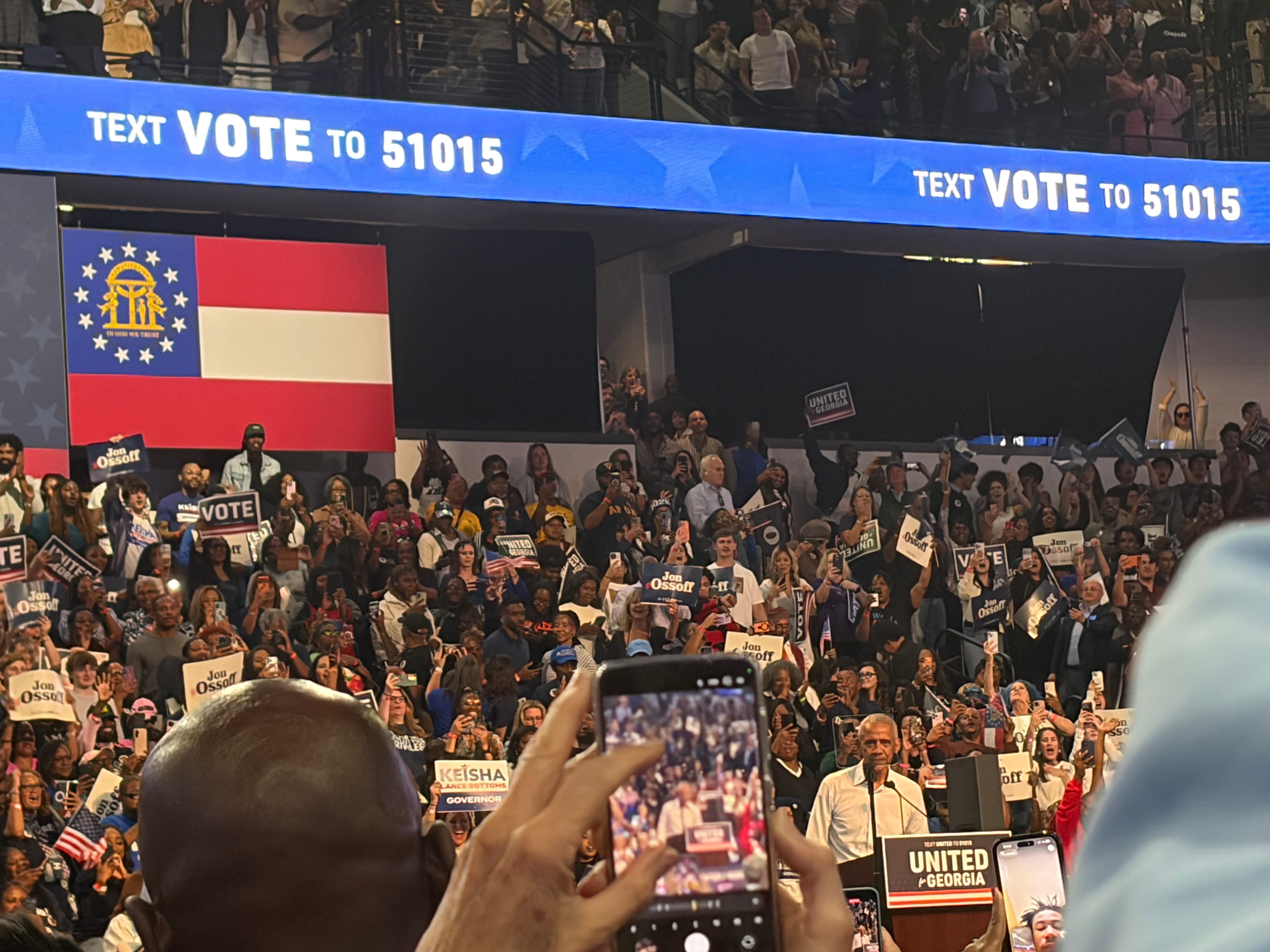
MORROW, GA.–On Wednesday, Democrats in Georgia from across the Peach State packed The Arena at Southlake with just six days until election day.
Ostensibly, former president Barack Obama came here to rally his party around Sen. Jon Ossoff’s re-election campaign and to lift up Keisha Lance Bottoms, the former mayor of Atlanta and the Democratic nominee for governor.
Jennifer Copeland, who drove more than three hours from Valdosta with a handful of other Lowndes County Democrats to the rally, told The Political Spectrum that she and her colleagues wanted to be with other Democrats and “that we’re looking forward to turning this state blue, from top of the ballot to the bottom of the ballot.”
“We also wanted to hear our policies from not only Keisha Lance Bottoms, Jon Ossoff, but getting to hear and be motivated by President Barack Obama,” she added.
Located just 16 miles outside of Atlanta, Morrow is located in Clayton County, which is about 71 percent Black. In 2004, about 70.5 percent of Clayton voted for Sen. John Kerry. In 2008, almost 83 percent of voters there voted for Obama. That tilled the field so that Joe Biden could reap the harvest of Joe Biden winning the state as well as Ossoff and Sen. Raphael Warnock’s victories in 2021.
But while Democrats broke through in 2020 and Warnock would win a full Senate term in 2022, Georgia has remained stubbornly red on the state level. In 2022, Republican Gov. Brian Kemp handily beat Stacey Abrams and the legislature remained under GOP control for most of the decade.
To be blunt, Democrats need another vote bank. As Republicans have become more competitive in states with large numbers of white non-college-educated working-class voters like Wisconsin, Pennsylvania and Michigan–once called “the Blue Wall”–under Donald Trump, they need to win in states.
And Southern states like Georgia and North Carolina feel ripe for the picking. With their large ethnically-diverse populations and large amounts of college-educated liberals moving to their cities, they increasingly have the coalitions needed for Democrats to compete.
“We are showing America that the wave we saw in Georgia that sent Sen. Jon Ossoff and Sen. Warnock to the United States Senate was not a fluke, it was just the beginning,” Bottoms said.
And this might be the time when Democrats can turn he tide. With Trump’s approval ratings reaching their nadir, this might be the best time for Georgia Democrats to win not just the governorship, but also possibly win the state legislature. Last year, Democrats flipped two seats on the state’s Public Service Commission.
There’s also the fact that many Black voters remain livid after the Supreme Court’s Louisiana v. Callais decision, which significantly weakened Section 2 of the 1965 Voting Rights Act. Since then, southern states including Alabama and Florida have redrawn their congressional maps to give Republicans advantages and dilute the power of Black voters.
The legislation has special significance in Georgia considering Dr. Martin Luther King Jr. made Atlanta and the Ebenezer Baptist Church, where Warnock now preaches, his home base. John Lewis, then a member of the Student Nonviolent Coordinating Committee, would have his skull fractured by authorities on Bloody Sunday on March 7, 1965. Lewis would go on to serve as the congressman for large swaths of the Black population in the Atlanta metro area.
Voters around Morrow told The Political Spectrum that the killing of the bill motivated them to vote.
“And a lot of our precincts, they either move far away, or they minimize them,” Valerie Austin, who lives in Fulton County, said. “It’s 1,000 houses in my subdivision. There’s no way we’re gonna go to a trailer parked at a fire station.”
Plenty of Black voters in the area invoked the history of the Civil Rights Movement.
“My ancestors and my grandparents and great grandparents who marched for this right, who fought for this right to vote, it is deplorable, and I feel like we need to do all that we can to make sure that this does not happen,” Angelica Ewing said.
But it’s clear that Democrats still have a massive challenge. For one, Bottoms is still in a neck-and-neck race against Rick Jackson, a self-funded health care executive and billionaire whom The Atlanta Journal Constitution reported has spent $220 million in his campaign for governor.
Polling averages show that Bottoms has a slight lead, though still within the margin of error. Jackson and her Democratic primary opponents criticized her for choosing not to run for re-election in 2021 during the height of the Covid-19 pandemic and when Atlanta had seen crime increase.
As the rally continued, it became apparent that Democrats called in Obama to shore up Bottoms, given that Ossoff is handily leading his Republican far-right opponent, Rep. Mike Collins, in polling. As the sounds of 2000s Atlanta hip-hop like Ludacris and Lil’ Jon and R&B singers like Usher pumped through the speakers before the rally started, the DJ regularly called on supporters to wave signs for the candidate.
And Bottoms is not as compelling as even other members of the statewide slate. Tanya Miller, the Democratic nominee for attorney general, and Penny Brown Reynolds, the Democratic nominee for secretary of State, both gave far more compelling speeches with massive applause lines.
It’s clear that many of Ossoff’s voters will likely crossover and vote for Jackson, something that rapper Killer Mike, one half of Run the Jewels, warned against.
“If you understand that she and Ossoff are a team to be sent into office for us, then you’ll vote for that team, and you’ll know that we have the right people,” he said.
And truthfully, there might not be another moment for Democrats to gain a foothold in Georgia on the federal level.
But even if Bottoms wins this race and flips only a handful of state legislative seats, it could signal the beginning of Democratic power in the state. And waves are the best opportunity to do this. Even as Georgia began to vote Republican on the presidential level in the 1964, the GOP only won the governorship in Georgia in 2002, during the post-9/11 Republican midterm wave. Subsequent party switches gave them control of the state Senate later that year and only in 2004 did the party win a trifecta in Georgia.
The same proved true in Virginia for Democrats. In 2005, Tim Kaine won the governorship in Virginia and Jim Webb would win a Senate seat, priming the pump for Obama’s victory in 2008 as more people moved into the Northern Virginia suburbs of Washington, D.C. But Democrats in the Old Dominion State would only win a trifecta in 2019 after a quarter-century lockout.
Tuesday is the perfect opportunity for Georgia Democrats to have a Virginia moment. But everything has to go right.
What I’m Reading: The New York Times’s profile on Keisha Lance Bottoms’s struggle to win voters after not running for re-elction as mayor of Atlanta explains the current political moment in Georgia. Eliza Griswold’s has a profile of Abdul El-Sayed in The New Yorker. Katie Rose Pryal’s piece on neurodivergent storytelling. Friend of the newsletter Natalie Fertig’s profile of Rep. Marcy Katpur of Ohio. Christopher Hooks’s profile of Ken Paxton in New York Magazine. Eva Hartog in Politico Magazine about why there will not be another Lula in Brazil. Center for NC Politics has satisfied my political sicko with its dashboard. My friend Rebecca Ching, MFT, PCC on cynicism. Madeleine Carlisle in The Atlantic on why Republicans’ redistricting efforts are going to hell.
Your regular Bam Bam post.
That’s it for The Political Spectrum. If you like what you read, hit subscribe below.