

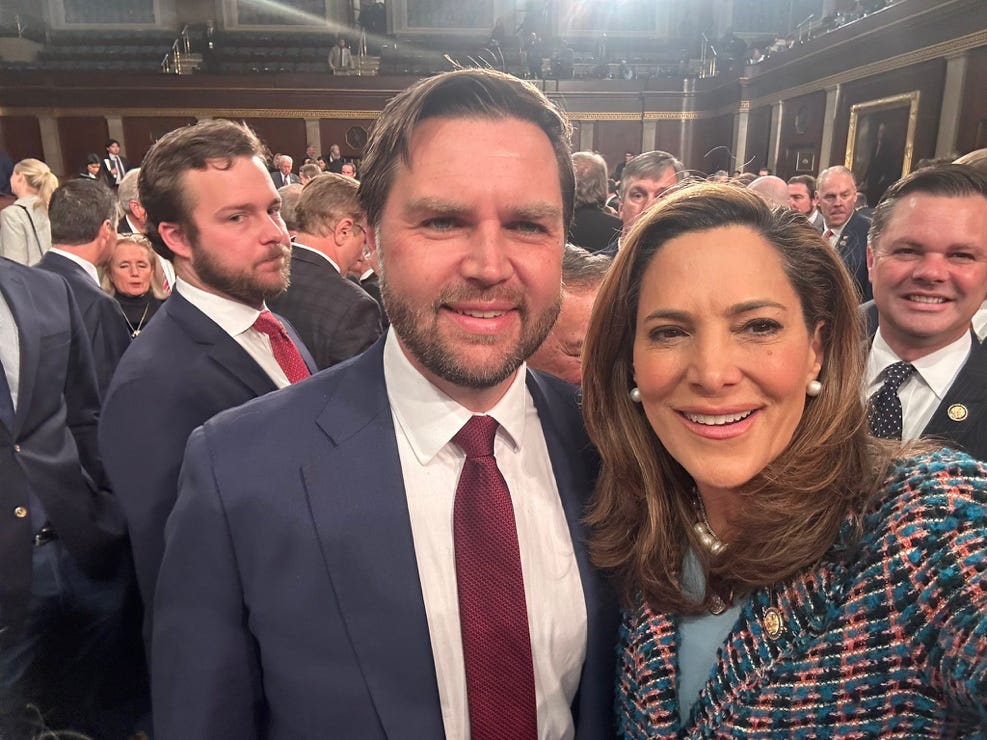
Welcome to The Political Spectrum! And now for something completely different: I’m going to try and take the interviews I grab on Capitol Hill and contrast them with what the data tell us. Hopefully, it challenges conventional wisdom.
As Republicans try to reckon with the drubbing that they received weeks ago in the 2026 midterm election, some of the Republicans are pointing the finger clearly at President Donald Trump’s immigration policy.
On Tuesday evening, Rep. Maria Elvira Salazar (R-Fla.), who is Cuban-American and who represents Miami-Dade County, specifically blamed the Trump administration’s immigration policy.
“We should have passed an immigration reform law called the Dignity Act,” Salazar told The Political Spectrum. “We would have kept every single Hispanic in the country, including Texas, Florida, North Carolina, everywhere, but we can still do it. We have two more years to go.”
Salazar sponsored the DIGNIDAD Act, also known as the Dignity Act, with Rep. Veronica Escobar (D-Texas) from El Paso. The legislation would simultaneously increase the pay of U.S. Border Patrol agents and create a nationwide system based off of E-Verify to ensure employers hire immigrants in the United States lawfully.
But it would also offer permanent resident status for undocumented immigrants in the United States, including recipients of the deferred action for childhood arrival (DACA) status. Those without lawful immigration status would have their deportation deferred provided they pay restitution, meet employment or education requirements and satisfy other conditions.
That’s unlikely to happen given that after the midterm election, Trump named Stephen Miller, the mind behind most of the administration’s immigration policy, to be his White House chief of staff.
Salazar has a vested interest in saying this since she has pushed the legislation since her first term.
She seemed to represent a new type of Republican. In 2020, she flipped Florida’s 27th district, which voted for Hillary Clinton by almost 20 points in 2016, in 2020 after Donna Shalala had won it in 2018. As former news anchor for Telemundo and a Cuban-American, she preached finding a third way on immigration, despite voting for the Trump administration’s beefing up of Immigration and Customs Enforcement in the One Big, Beautiful Bill Act.
But on Election Night, it looked like the Blue Wave might hit Hialeah. Salazar beat Democrat Eliot Rodriguez by only 1,086 votes. By contrast, she won her 2024 race by almost 21 points when Trump became the first Republican to win Miami-Dade County since George H.W. Bush.
And what about Democratic Senate nominee Angie Nixon, a self-identified democratic socialist? Surely she must have done poorly with people who escaped the communist regime of Fidel Castro? Nope. Despite losing the race to Sen. Ashley Moody, who replaced Cuban-American Secretary of State Marco Rubio, Nixon won Miami-Dade and it swung 8.6 percentage points compared the 2024 Florida Senate race when Sen. Rick Scott beat former Democratic Rep. Debbie Mucarsel-Powell.
Of course, the same dynamic played out in Texas. Unlike Miami, Texas’s Rio Grande Valley is predominantly Mexican-American. But similar swings happened. In 2024, Trump flipped Hidalgo County right on the border with Mexico with 110,560 votes.
But Democratic Senate nominee James Talarico beat Ken Paxton with 72 percent of the vote and 146,723 people voting for the state legislator compared to only 52,660 voting for Attorney General Ken Paxton. This came after Trump endorsed Paxton in the GOP primary instead of four-term incumbent Sen. John Cornyn.
Cornyn said in his experience, Hispanic voters historically voted Democratic, but will vote for Republicans and develop personal relationships with elected officials.
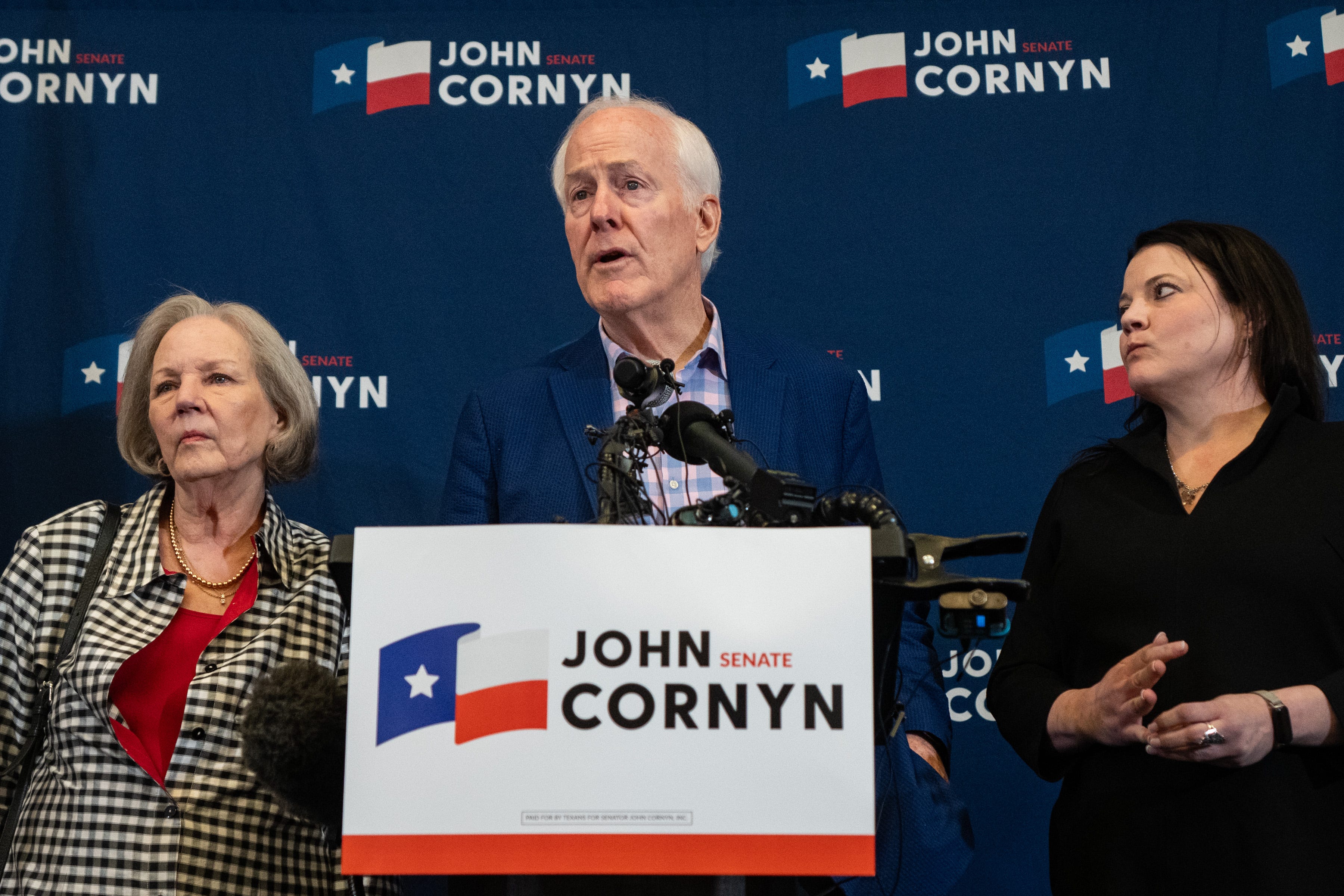
“And unfortunately, I think because of the hyper-aggressive immigration enforcement, that a lot of them were put off by that,” he told The Political Spectrum.
Cornyn said that type of enforcement differs from border security, noting how many in the Rio Grande Valley want border security. Hispanics make up about half of Border Patrol officers, according to a 2010 survey of the workforce at the Department of Homeland Security by the U.S. Equal Employment and Opportunity Commission.
But Cornyn warned that even they are put off by Trump’s policies of mass deportation, despite the fact Trump campaigned explicitly on the message.
“They wanted border security,” Cornyn said. “But they didn’t want overly aggressive immigration enforcement against people who hadn’t really committed any serious crime.”
Salazar and Cornyn are correct that Hispanic voters–whether they be Cubans in Calle Ocho or rancheros in McAllen–were repulsed by Trump’s immigration policies. But that only tells half the story.
It is objectively true that Hispanic voters in across the board were repulsed by the Trump administration’s deportation policies. Equis Research, which tracks Latino voter sentiment, found in a survey released the day before the election that found that Democrats now have an 18-point advantage on immigration. The specific excerpt does it more justice:
The contrast between what many Latinos expected from Trump and what they got has helped feed the narrative of broken promises. It has also pulled attention away from the border and toward the impact of broad deportations on long-term residents, especially families and children. That shift matters, because Republicans are more trusted on the border than on immigration overall.
Trump–and Texas Gov. Greg Abbott, who also lost re-election earlier this month to Democrat Gina Hinojosa–largely succeeded during Joe Biden’s presidency in framing immigration in the mind of many voters, including some Hispanics, as an issue of crime and safety. But raids in Chicago, Minneapolis and elsewhere turned immigration into a matter of civil rights and not going after hardened criminals.
The same appears to be true even in Miami, where even 78 percent of Cuban voters say Immigration and Customs Enforcement (ICE) has gone over the line, according to a survey from UnidosUS.
But if Republicans think they can win back Hispanic voters purely on immigration, they are sorely mistaken. In October, Carlos Odio, the co-founder of Equis, and Rachel Stein, the chief scientist at Equis, wrote that the economy and the Iran War are by far the biggest problems for Republicans:
Among the reasons Latino Trump voters give for being disappointed in him, three are the most cited: broken promises, the mishandling of the economy, and the war. Those aren’t unrelated matters. The war is not just about the war. Voters link it to the economy (their #1 issue by a mile) and to Trump’s campaign commitments: “They need to terminate the war so that prices will get back to normal,” said one disgruntled Trump voter. “He promised no more war,” said another. “He is not for America First.”
That last sentiment, especially, speaks to a core reason that the last voters into the Trump coalition might be the first ones out: he walked away from the set of material, nationalistic promises that had attracted them to him in the first place. The war brought to violent boil a narrative that had been simmering since the tariffs of April 2025: that the president is attending to priorities other than those of the people who elected him.
When it came to immigration, they said:
Yes, there is the matter of Trump’s immigration policies, which have been a prominent ingredient in the stew of discontent, as we will write more about in a future post. But to narrow displeasure with Trump to immigration alone repeats a mistake of the last decade, in flattening the Latino vote down to a single issue.
Iran is no less central to the calculus of disgruntled Latino voters than to that of other voters. In some ways, it might even be more meaningful.
UnidosUS’s national survey released the day after the election said the same thing. It showed that 58 percent of Latinos considered inflation and the cost of living as one of their top three issues, while 35 percent said jobs and the economy, 29 percent said affordable housing and rent, 30 percent said the cost of gas and 29 percent said health care costs.
Immigration clocked in at 27, so while still important, is one of many issues. And by far Trump’s worst issue was the war with Iran, which is at a net -44 percent.
And the Latino swing happened in a fairly uniform manner, albeit a differing velocities. VoteHub found that Mexican-Americans in Texas; Mexican Americans in Georgia, Florida, Michigan and Nebraska; Central Americans in Texas, Florida, Georgia and Nebraska; Puerto Ricans in Florida; Venezuelans in Florida; and Miami Cubans all swung 14 to 20 points to the right in 2024 compared to in 2020.
But in 2026, these groups all swung between 18 to 37 points to the left, with Texas Mexican-Americans voting for Democrats by 53 points. Miami Cubans being the only group that still voted Republican, but only by four points.
All of this shows that Republicans face deep structural problems with Latino voters. The Trump era has shown that Hispanics are not one major bloc of swing voters: they are the swing vote. And even on the remote chance Trump and congressional Democrats pass bipartisan comprehensive immigration reform legislation, the mistrust among Latinos toward Republicans will persist.
¡Dios Mio!: To give people an understanding how massive the Latino swing was, in California, CBS News reported that election data firm PDI found that Latino turnout in California jumped from 28 percent in the 2022 midterms to 41 percent in 2026. The New York Times found that Hispanic voters with a degree shifted 18 points to the left in 2026 compared to 2024 and Hispanic voters without a degree moved 36 points to the left.
Who I recommend following: The New Dynamic, which I tagged in the post. And also, our buddy Mike Madrid. Here was our live chat as the election results happened, where you get my live reaction to Talarico winning. The nerds at VoteHub’s breakdown of how Latinos are de-aligning, not re-aligning, is a must-read.

Your regular Bam Bam post:

That does it for this edition of The Political Spectrum. Your support pays for this kind of reporting and analysis. Please consider a paid subscription.