

Edited by Andrew Donaldson
I don’t know about you, but I’m feeling 22 days until the midterm election. Hence, it feels like a perfect night to talk about polling.
And that means everyone is getting twitchy about the midterm elections. Republicans right now are hoping that the polling is off and that, as usual, pollsters are missing supporters of President Donald Trump. Democrats, meanwhile, are trying not to engage in too much euphoria since they have burned too many times by pollsters.
But it’s getting harder for Democrats to deny they have the momentum. Reuters/Ipsos’ survey of the generic congressional ballot, which asks if voters would prefer a generic Democrat or Republican to represent them in the House of Representatives, shows Democrats have a seven-point advantage. Democrats also have significant leads in states that Trump won three times like North Carolina, Ohio and Texas. And other surveys show them at least competitive in red states like Kansas and Iowa.
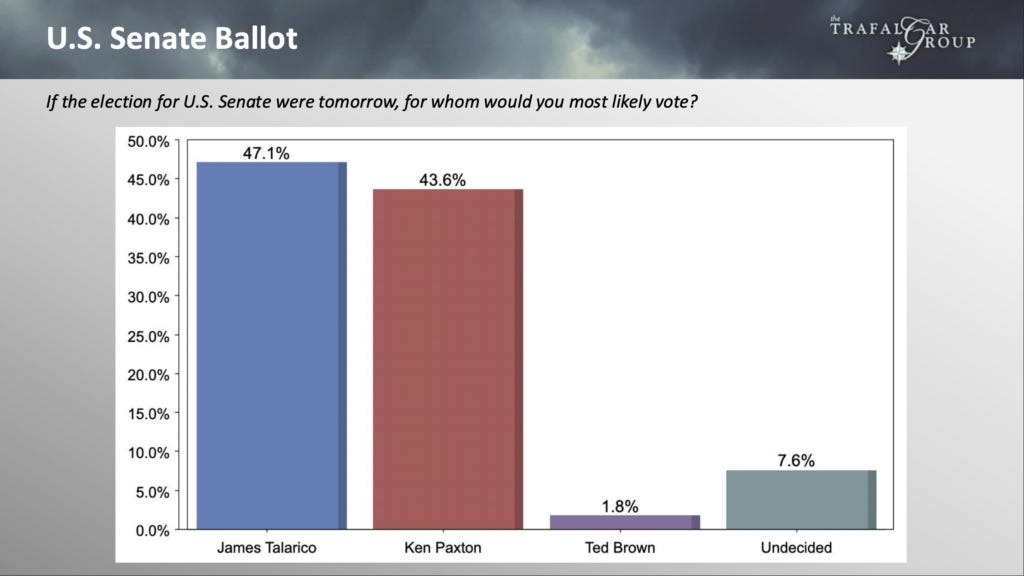
Still, Trump decries “fake polls” that don’t factor in his campaigning. But over the weekend, Trafalgar, the Republican-leaning pollster, released a poll showing support for Democrat James Talarico at 47.1 percent and support for Republican Ken Paxton at 43.6 percent. What’s more, Talarico’s lead is outside the survey’s 2.9 percent margin of error.
The lack of faith in polling makes pollsters’ jobs even more difficult.
“There’s not a single pollster out there that is decent that isn’t obsessing about this question,” Natalie Jackson, the founder and principal for Centerline Research, told The Political Spectrum. “Republicans are just the largest, most obvious group when you’re doing political polling.”
Jackson said pollsters struggle to get voters without a college degree, people who work in labor-oriented jobs where they don’t have time to talk on the phone.
“Republicans have particularly turned on polling,” she said. “There’s anecdotal evidence that Republicans are opting out even more this year. The question we don’t know the answer to is whether that means they vote.”
The question of whether Republican voters turn out is probably the most vexing question for both Democrats and Republicans. An Economist/YouGov poll last week showed that a combined total of 59 percent of Democrats are more excited about voting in the 2026 midterm compared to the 2022 midterms while 54 percent of Republicans say the same.
That is partially why Chaz Nuttycombe, who runs the nonprofit State Navigate, flagged Iowa as a potential place for a polling miss. Last week, he flagged that in Iowa’s 35th state senate district, plenty of Republicans are lying about their vote for Trump in 2024 and rural Iowa Republicans are ignoring the survey.
“It’s not rural voters necessarily; it’s rural Republicans,” Nuttycombe told The Political Spectrum. He contrasted that with rural Democrats, who did want to answer the phone.
“I checked, but a lot of Republicans are just lying about not voting for Trump in 2024,” he said. Lakshya Jain of Split Ticket also noted the trend of Trump voters not saying the backed him in 2024 in his polling.
In a state like Iowa, this could be make or break. While Democratic nominee for governor Rob Sand leads most polls against Republican Zach Lahn, polling for the Senate race is much more mixed. Emerson College, The New York Times/Siena University and CNN/SSRS polls showed Republican Rep. Ashley Hinson leading, while Fox News and Suffolk University showed Democrat Josh Turek leading. Even a slight polling error can mean the difference in races like Iowa.
Of course, there is always just the fact that the fall is the time when politics junkies and casual voters pay more attention and campaign ads flood everyone’s airwaves. So people just want some sign about what exactly is going to happen.
“October always makes everybody a little crazy on polling,” Jackson said.
That’s it for today’s edition. This newsletter be non-paywalled leading up to the midterm election, afterward it will require a paid subscription for premium content. Subscribe below and see you tomorrow.