

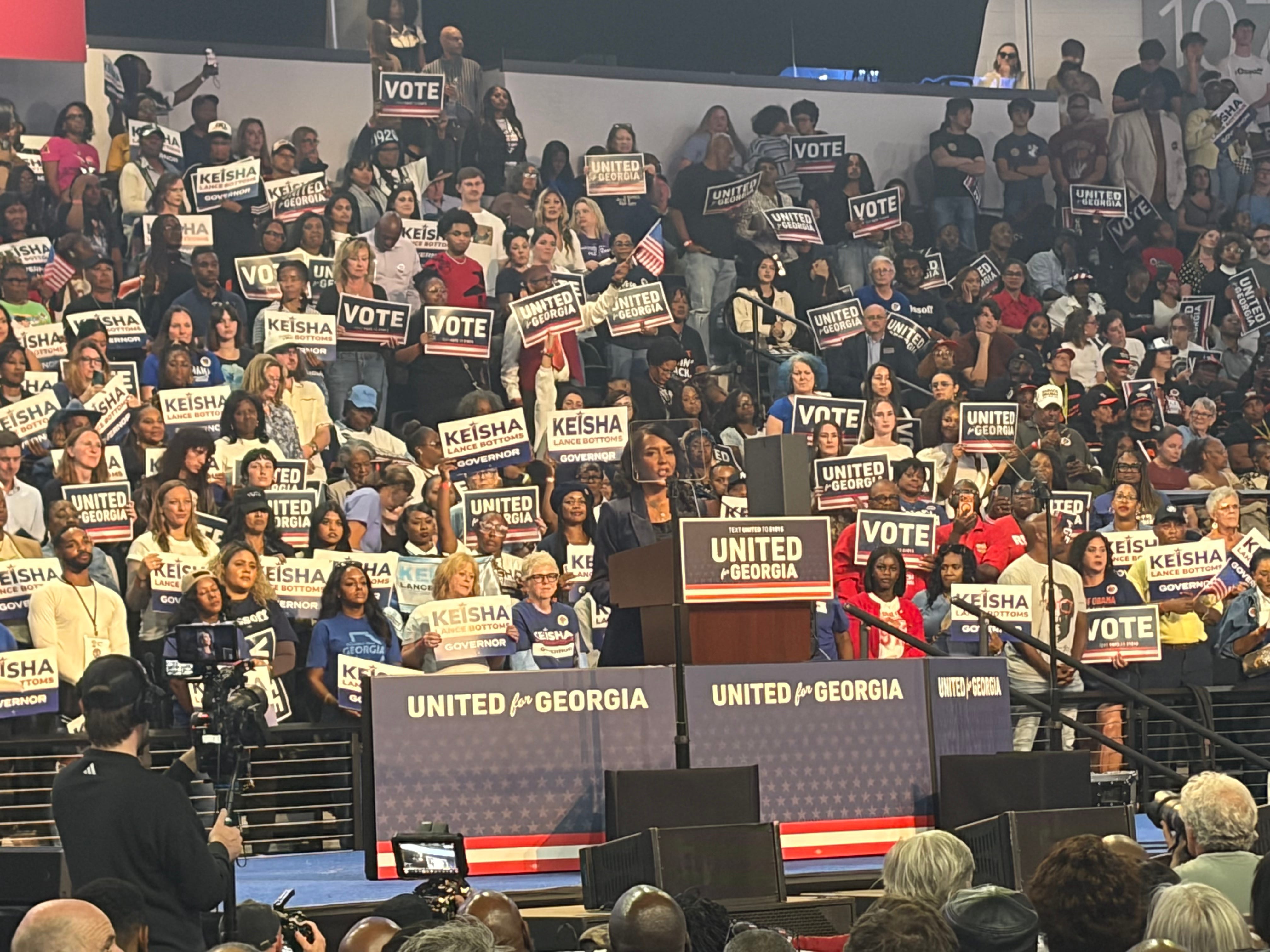
Welcome back to The Political Spectrum! First and foremost, I want to say “Thank you” for supporting the Substack. Without you, I could not have reported in North Carolina or Georgia. Now I am once again asking for your support: I would love to go to Mississippi for Election Day to cover the Senate race. If you appreciate this coverage and are a free subscriber, please consider becoming a paid one, or supporting this page on Ko-Fi.com/EricMGarcia.
On Saturday, I wrote about how Georgia Democrats have a real shot at gaining a foothold in the state government this midterm.
But both states love having close election results. Here’s five observations from being on the road in North Carolina and Georgia.
Young Black voters are turning out
Throughout speaking to young voters in both Greensboro, N.C. and Morrow, Ga., plenty of them emphasized the need to turn out.
“I just pretty much decided it was time instead of just scrolling and just constantly seeing people vote,” Jaylun Griffin told The Political Spectrum. “I was just like, ‘let me go ahead and do it.’”
Many young Black voters in Georgia also cited the Civil Rights Movement and the fact that the Supreme Court significantly weakened the 1965 Voting Rights Act in the Louisiana v. Callais ruling earlier this year.


“I think it’s deplorable because, as a Black American, my ancestors and my grandparents and great grandparents who marched for this right, who fought for this right to vote, it is deplorable,” Angelica Ewing said. “ I feel like we need to do all that we can to make sure that this does not happen.”
Early voting data seems to bear this out. According to Djsokespeaking, a great X account tracking early voting, 106,739 Black voters between the ages of 18 and 29 cast their ballots early in Georgia which is 170.5 percent of their early voter turnout in 2022. It’s difficult to know how many young voters cast their ballot for Democrats because Georgia does not have party registration. But given the way voters are polarized by race in Southern states, it does feel like a positive sign for Democrats.
The same proved true in Greensboro, where younger voters specifically expressed frustration at the fact the Guilford County Board of Elections denied a request to have an in-person early voting site on campus.
“Them taking away our poll is like okay, they’re not gonna go out and like do what they do to go vote, have their voice, and but obviously we proved them wrong,” Kyra Brice told The Political Spectrum in Greensboro. Specifically, she cited the price of gas and groceries as reasons to vote.


Democrats also have good reason to feel optimistic in North Carolina, where 126,103 registered Democratic voters between ages of 18 and 29 voted early in person compared to only 62,577 in 2022.
The Senate races are just the appetizer
Much of the focus in both states has been on the marquee Senate races. And with good reason. Sen. Jon Ossoff (D-Ga.) looks ready to stomp Rep. Mike Collins and cruise to re-election, while former Gov. Roy Cooper in North Carolina is all but guaranteed to win his race against Michael Whatley.
But the real prize this cycle is state-level control. In addition, North Carolina Democrats have the opportunity to not only win a Senate seat, but also hold a seat on the North Carolina Supreme Court and potentially even flip at least one chamber in the General Assembly after Democrats had been locked out of both chambers since 2010. Uncrewed has a great breakdown here. It also tees Democrats up to potentially flip the court in 2028.
In Georgia, Democrats are not only vying for the governorship in Keisha Lance Bottoms’s race against Rick Jackson: they have a shot at winning the state legislature for the first time in more than two decades.
Most voters I spoke to seemed excited about the governor’s race, even as they said the entire ballot is important.
Darlene Joseph said when it came to the governor’s race, she was most excited about “ just putting a Democratic representation in place.”
Data Centers dominate campaign talk
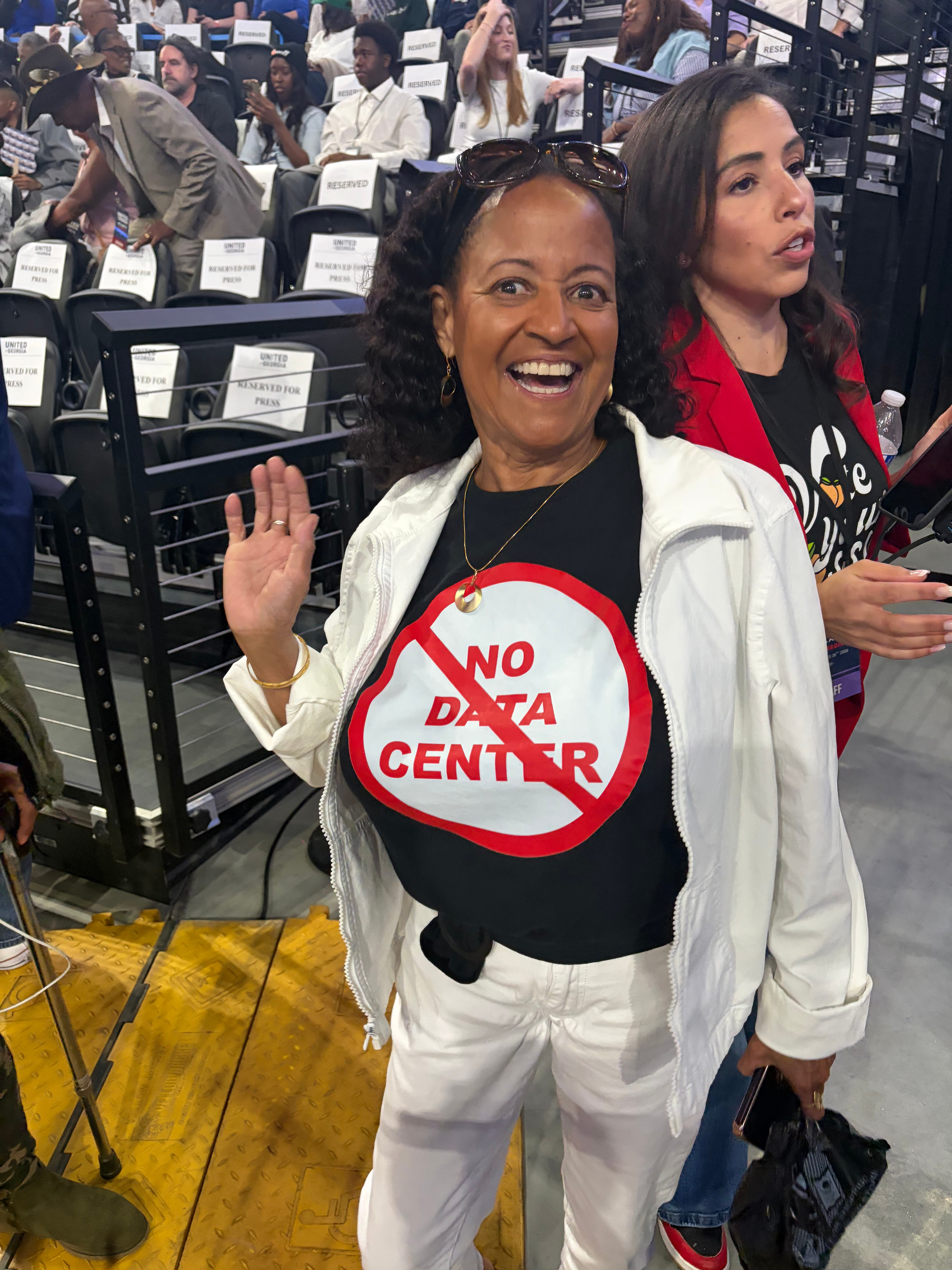
By now, anyone knows that 2026 is the year of the anti-data center candidate. Whether it’s Will Lawrence running for Congress in Michigan’s 7th district or Gina Hinojosa running as the Democratic nominee for governor in Texas, candidates who are running against data centers have made it a winning issue.
This also proved true in Georgia. But for the most part, it’s been coded as an issue that affects mostly white rural voters. At the rally in Morrow, however, I saw two older Black women wearing shirts opposing data centers. During her speech, Bottoms specifically said she would pause construction of data centers and hit Jackson for his support of them.
“Trump-supported data centers? Slick Rick owns not one, not two, not three, but four companies that are investing and building data centers as we speak,” she said.
This likely will not be the last time that AI and data centers will come up. With fear of AI running amok, expect potential Democratic trifectas to try and put some guardrails in place.
Barack Obama is still ‘the best closer we have’ for Democrats–and it’s a problem
As I wrote in Zeteo this week about Ossoff, at one point when he began to introduce Obama, Ossoff borrowed Obama’s old line and asked the crowd “are you fired up? Are you ready to go?” It was a reminder that almost a decade after he left office and fourteen years after his last presidential campaign, it’s still Obama’s party.
Back in 2022, Malcolm Kenyatta, now a vice chairman of the Democratic National Committee, told me that Obama was “the best closer we have.” Later that month, I went down to Pittsburgh for Obama’s rally with then-Democratic Senate candidate John Fetterman. At the time, Democrats were ringing their hands about Fetterman’s difficulty communicating after he suffered a stroke. But Obama made the case he was the right candidate. It seemed to make the case for voters.
Obama is still the guy Democrats want on the wall when they need help. His rally with Abdul El-Sayed last month was the stamp of approval El-Sayed needed when many Democrats remained leery of him. He’s still the guy to make clutch plays.
This became abundantly clear when Obama shot back after Republicans had spent the week saying he was elitist for saying “He’s got the White House looking like Saddam Hussein opened up a Cheesecake Factory.”
During the rally in Morrow, Obama shot back at them.
“They didn’t say anything about that. The president wasn’t even mad about the Saddam Hussein comparison,” he said. “That part didn’t bother him, but he was very upset about the Cheesecake Factory.”
But so far, there has yet to be a generational talent on the level of Obama to stand into the void for Democrats. Even some of the most charismatic figures like Zohran Mamdani, Ossoff, Alexandria Ocasio-Cortez or El-Sayed have limited appeal or are simply reworking his best lines. It’s unclear they will be able to create something new that will strike lightning with a new generation the way Obama did with millennials.
2026 is a chance to diversify the Democratic bench
In 2018, Democrats elected a record number of women and many of them have gone on to become senators and governors. Shortly thereafer, former Republican House Speaker Kevin McCarthy said “When you look at the Democrats, they actually look like America. When I look at my party, we look like the most restrictive country club in America.”
But in 2026, many of the Senate candidates are white men. Ossoff, of course, is a white man, as is Cooper in North Carolina. In Iowa, Democrats nominated Josh Turek to run for Senate. In Maine, Democrats nominated Troy Jackson, a white man, to replace Graham Platner, another white man, as their nominee to run against Sen. Susan Collins. And in Texas, they nominated James Talarico to run against Ken Paxton.
This is a longstanding problem for Democrats. In 2024, I wrote about how Democrats have long relied on the labor of Black women but they have not done a great job of elevating Black female talent. Part of this is also trauma after Harris and Hillary Clinton lost to Donald Trump, despite the fact that during those same years, Democratic women did quite well electorally, even in states Trump won.
But a bit lower on the ballot, Democrats have a chance to diversify their benches. Ossoff has the chance to not just make Bottoms the first Black female governor, but also make Tanya Miller, another Black woman, attorney general of Georgia and Penny Brown Reynolds, another Black woman, to be secretary of state. Cooper’s victory in North Carolina can help carry Anita Earls, the only Black woman on the supreme court, to victory.
All of this can help diversify the bench for when future elections come. And this is to say nothing of rising state legislators in swing states who can ascend to the future.
Writing hither and yonder: The aforementioned Zeteo piece on whether Jon Ossoff can make a run for the White House. Much thanks to Andrew Perez for edits and Mehdi Hasan for letting me write for them
What I’m reading: In Politico Magazine, my former Daily Tar Heel colleague and UNC classmate Liz Crampton on Texas Gov. Greg Abbott being in the fight of his life. Mike Konczal on why 2028 won’t be an ideas primary. I ran into Jonathan Martin at the Ossoff-Obama-Bottoms rally and his Politico column delves into the “Blacklash” about the Voting Rights Act I discussed above. Rivka Galchen in The New Yorker on how A.I. is changing math.
Your regular Bam Bam post:

That does it for us here. If you like this post, please consider subscribing.
Lots to think about here. If it’s possible, I would love to know more about the disability rights background of Hayley Stevens’ fiancee.