

Edited by Andrew Donaldson
We have 21 days until the election. Tonight, Democrat Josh Turek debate Republican Rep. Ashley Hinson Iowa’s open Senate seat. Republican Sen. Susan Collins will debate Democrat Troy Jackson in Maine.
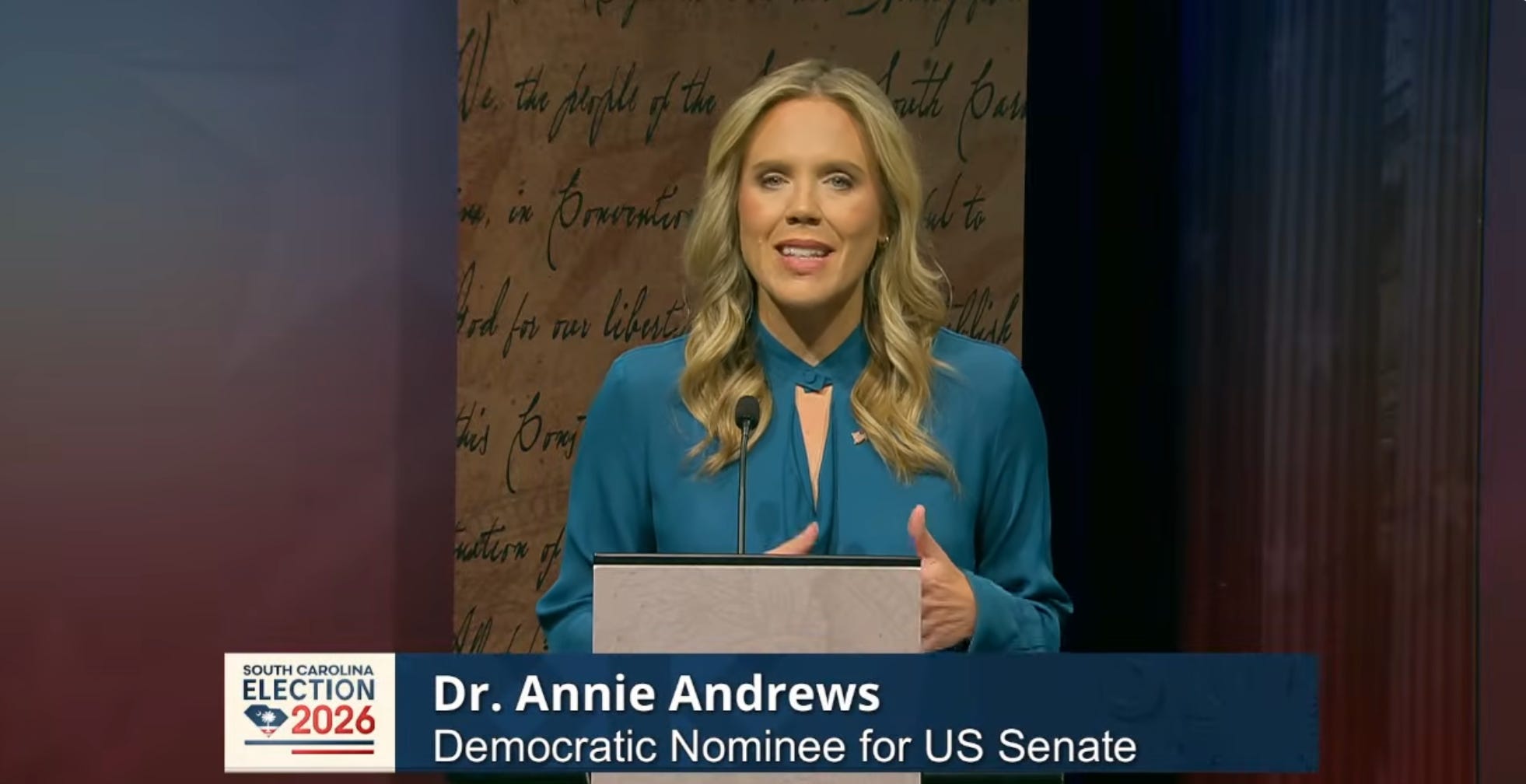
On Sunday, toward the end of the South Carolina Senate debate, Sen. Darline Graham (R-S.C.) tried to get one last hit against Democrat Annie Andrews by saying, “let’s talk about a couple of other concerns I have that she’s deceiving the people of South Carolina with these transgender issues,” before the moderator cut her off because of a lack of time.
This attack came after President Donald Trump called Andrews “Annie ‘Trannie’ Andrews,” a slur used against transgender people.


Andrews responded in an ad saying, “I don’t support biological men playing women’s sports, and I don’t support and haven’t ever performed gender surgery for minors.” Republicans then flagged an old tweet of Andrews calling legislation in South Carolina to ban transgender athletes from women’s sports “shameful legislation.”
Republicans think they can make lightning strike twice as polling shows many Americans oppose transgender athletes in women’s sports. But LGBTQ+ activists and Democratic strategists argue Democrats are playing into right-wing talking points at a time when Republicans are losing the argument around transgender people.
Kelley Robinson, the president of the Human Rights Campaign, a pro-LGBTQ+ rights organization, told The Political Spectrum that the episode shows that Republicans are throwing out anti-trans messaging because they have little else. She also said that while most Democrats are standing up for transgender people, there are “a handful of folks that I think are getting it wrong or still have a lot of room to grow.”
“What I saw in South Carolina was the president launching a slur and bullying a candidate for the United States Senate,” she said. “What I would have loved to see is her response with empathy and care for the community and not feed into his bullying and lies, you know. I think that there were better ways to do that that could have really gained her ground with voters, and there’s still room for her to do better.”
Andrews is far from alone in her rhetoric opposing transgender athletes in women’s sports. In Ohio 9th District Democratic Rep. Marcy Kaptur ran an ad saying “I voted with Republicans to keep transgender ideology out of our schools” and “boys should not play in girls’ sports.” And in North Carolina’s 1st District, fellow Democratic Rep. Don Davis ran an ad saying “there’s real concerns about fairness and safety,” adding that “states should decide what’s right for protecting women and girls.”

Both Democrats represent districts that voted for Trump in 2024, and their states were heavily redistricted to shore up Republicans, so they naturally believe that they need to adopt some moderate positions. And plenty of Democrats remain spooked by anti-trans ads since the Trump campaign’s infamous 2024 ad which featured Kamala Harris supporting gender-affirming care for transgender inmates, before saying “Kamala is for They/Them. President Trump is for you.”
Robinson compared the current onslaught of anti-trans ads and the defensive crouch by Democrats to the 1990s and 2000s, when many politicians opposed same-sex marriage, opposition she said came from the fact that many Americans didn’t think they knew someone who was gay or lesbian.
“We’re just at the beginning chapters of it for the trans community,” Robinson said. “Right now we’re really focused on storytelling, on visibility, on sharing the impact of these laws.”
But it’s not just progressives who have said that Democrats can beat back Republican attacks on transgender people. Lanae Erickson, the senior vice president for social policy, politics and education at the centrist group Third Way, told The Political Spectrum that the group has done 40 rounds of research on the subject.
“I think what they failed to understand is while they did have an appeal to voters, voters were mostly worried about the economy and broader things that were going on in their lives,” Erickson said of Republicans’ anti-trans ads in 2024. “And the transgender attacks were just another example of what they thought were misplaced priorities of the Democrats in the Biden administration.”
Erickson said that the most effective way to talk about transgender people has been for Democrats to talk about having rules in sports but not laws.
“In some instances, that might mean that a transgender girl might not be able to participate if it’s at a very high level of competition,” she said. “But those rules don’t need to be the same for college and kindergarten. And these ideas of just blanket bans are not actually about fairness. They’re actually just about being mean to transgender people.”
Some Democrats have already tried experimenting with this. In Iowa’s 2nd District, Democrat Lindsay James ran an ad saying “we need commonsense rules to keep sports fair for boys and for girls.” In Texas, Democratic Senate candidate James Talarico told Fox News that he would “oppose trans athletes playing in girls’ sports if it risks safety or fairness.”
“So I think that the Talarico approach acknowledges that there are instances in which it might be unfair, and we do need to have rules, but leaves space to oppose these unnecessary blanket bans, and is just much more respectful in the language than the idea of just calling transgender girls boys,” Erickson said.
There’s also the fact that Democrats are likely seeing the tide turn their way. Last year, Democratic candidates for governor Mikie Sherrill in New Jersey and Abigail Spanberger in Virginia faced millions of dollars in anti-trans attack ads, but both won by double digits.
Since then, Spanberger killed a rulemaking effort by her Republican predecessor, Glenn Youngkin, that would have restricted transgender students’ ability to play sports and use girls’ facilities. And in New Jersey, Sherrill signed legislation that provides legal protections for people seeking abortions or gender-affirming care in the state from out-of-state interference.
That’s it for today’s edition. This newsletter be non-paywalled leading up to the midterm election, afterward it will require a paid subscription for premium content. Subscribe below and see you tomorrow.